
 Let’s be real, we’ve been there. You click on a slick new item online, prepared to splurge, and then… You read the fine print. It’s a dry, sterility-ridden block of text that reads like it was cobbled together by a bored robot in 2005. It calls out the amenities, but it doesn’t say a word to you. It doesn’t bridge the gap between the product and your life, your needs, or your ultimate desires. And boom, you’re a click away.
In the frenetically hyper-competitive world of e-commerce, that generic, one-size-fits-all strategy is officially withered. The magic ingredient that makes conversions soar, return rates plummet, and people fall in love with your brand is personalization. Yet how on earth would you be able to create a thousand versions of that product description for a thousand different customer segments without employing an army of copywriters?
As you may have surmised, the answer is Artificial Intelligence.
Welcome to 2025, where product AI won’t just be in the copy-drafting phase: it will be your super-efficient, data-loving, conversion-obsessed virtual marketing team. We’ll be delving deep into the individual AI behemoths that are spearheading this revolution, to investigate not just what they do, but how they’re using cutting-edge machine-learning techniques to speak to each of your customers in the way that feels most natural. Trust me, if you’re running an online store, knowing this frontier is not an option — it’s necessary for survival.
Why Customized Product Descriptions Are Not Only a Fad, But an E-commerce Must-Have
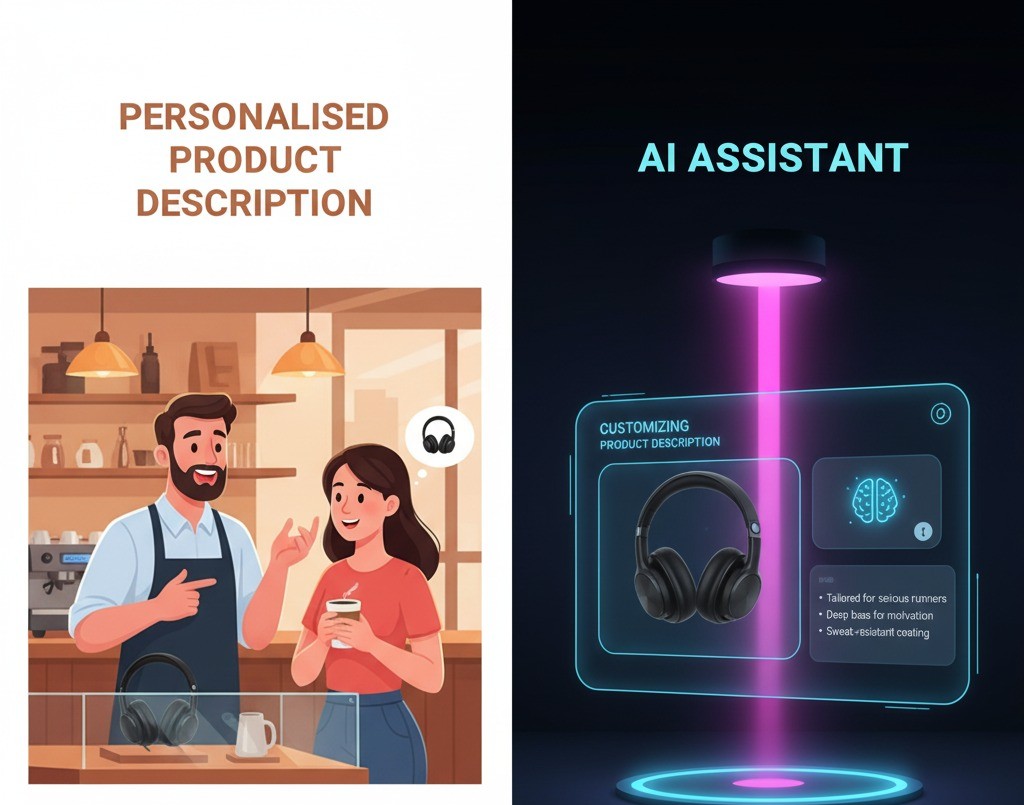
Imagine your favorite, quirky local shop owner. They know your name; they know your style, and when you try a new jacket on for size, they don’t say “That’s rabbit fur”; what they do say is: “You’re gonna love how that color complements the trousers you bought last month, and the cut will suit your build just right!” That’s personalization, and it is what consumers expect online.
The truth is, online shopping can be impersonal; personalization, then, is your comfiest blanket. It operates between the static digital storefront and the dynamic human brain.
The Personalization Requirement: Driving Conversion And Reducing Returns
We’re not talking about a slight improvement here. The numbers speak for themselves; simply delivering personal content will multiply your conversions by a considerable amount. Why? “The reason that description is powerful is because it’s not meant for everyone, but a specific piece of the audience in mind.” Because the more niche your own tale (tailor?) SoundsSie beispitzt The better.It’s describing what they feel as pain points and aspirations.
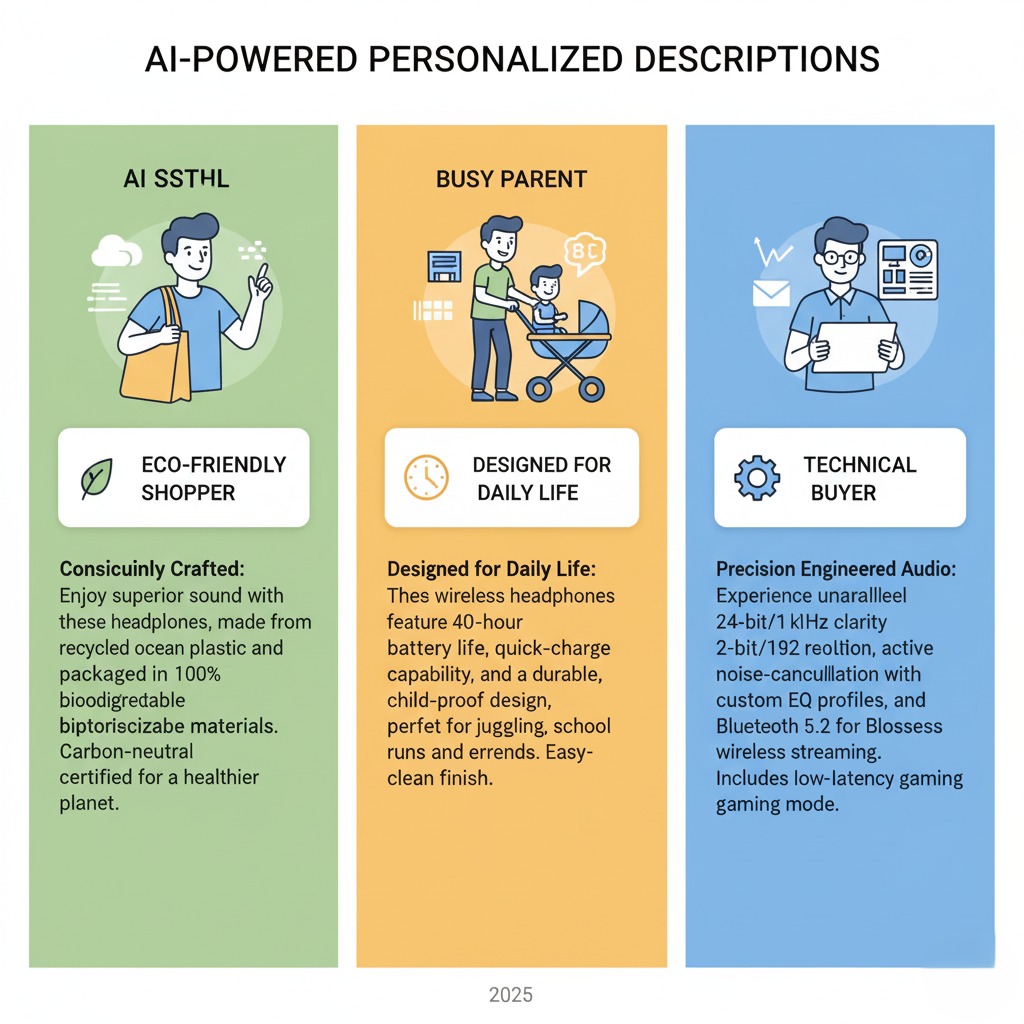
For the SEO shopper: If you’re interested in technical specifications and don’t care about anything else, this description emphasizes that it’s affordable.
For the Eco-Friendly Consumer: The Copy addresses sustainable materials, ethical sourcing, and reducing the carbon footprint.
For the Busy Parent: The description underscores its strength, convenience, and simplicity.
When the product description seems to speak directly to a shopper’s internal monologue, the buying decision is easier and faster and feels more — what could I call it? And here’s the best part: clear, narrowly-defined descriptions result in fewer returns. When the Copy correctly frames a cool product, it steers them away from being disappointed when they use it: you know what to expect. It’s a win-win situation.
 Beyond the Copy-and-Paste Job: Why Most Templates Suck
For years, e-commerce managers have used one of two options: a boilerplate description or a few manually generalized templates. We used to say: “Just plug in the color and size and material, and we’re finished!”
But those templates had a fatal flaw: They treated every visitor the same. Consider a twenty-year-old potential customer and a fifty-year-old one eyeing the same ergonomic office chair. The student is concerned about both the cost and the appearance of their small dorm room. He’s practical — both in terms of lumbar support and long-term investment. If you write in a way that serves them both equally, you fail to resonate with either of them completely. AI shatters this limitation. The best tools can achieve this using Customer Data Platforms (CDPs) and on-site behavioral analytics, providing dynamically generated descriptions that are served in real-time to the visitor. It’s like the difference between a mass-produced pop song and a bespoke symphony composed for you alone.
The AI Powerhouses: Leading Candidates for Customized Product Descriptions in 2025
Generative AI is moving at warp speed, and by 2025, a handful of platforms will emerge as the gold standard in e-commerce copywriting. This isn’t glorified word processing; these are powerful engines that can combine data, brand voice, and SEO logic to generate Copy at scale.
Jasper AI: The E-commerce Creative Content King
When considering high-quality, long-form writing, Jasper AI is almost always the first name that comes to mind. The reason why it’s regarded as one of the best AI tools for tailor-made product descriptions in 2025 is its well-developed BrandVoice Compliance. You can feed Jasper your brand guidelines, your past copywriting successes, and even your company’s “about us” page, and the system will learn to write in the style that’s true to you — whimsical, professional, cheeky, or authoritative — for every product you sell.
In terms of personalization, Jasper comes in strong by allowing you to build intricate customer personas directly within the prompt. Instead of using a single template that reads “Product Description,” you use the following internally: “Create a description for our ‘Cosmic Blender’ for the persona ‘Busy Millennial Parent’, centered on speed and clean-up.” The result? Copy that is less about describing and more about talking to your best bud.
Copy. AI: Workflow Automator for Mass Descriptions
For those of you who face challenges not in creating high-quality one-offs, but rather in managing a “catalog” with hundreds or thousands (or tens of thousands) of SKUs (Stock Keeping Units), Copy. AI is your best friend. It’s all about its “Workflow” and “Infobase”.
Picture yourself importing a CSV file with 500 products, all frugally provided with just the simple info (SKU, colour, and basic features). Copy. AI’s workflow engine handles that file and automatically creates a unique, SEO-optimized description for every entry in it. That’s critical for personalization at scale. By plugging it into your PIM (Product Information Management) system, you can generate a variety of descriptions that is not possible for every product in your catalog when you want to target just one campaign, like “Back-to-School shoppers” or “Holiday Gift Buyers,” segmenting even further without having to have someone write the backspacing on the first page of any of these.
Check out our in-depth comparison of Copy.ai vs Jasper.ai here.
 Describely (by Copysmith): A hyper-specific E-commerce wizard
While Jasper and Copy. AI is as flexible a generalist; tools like Describely signify the arrival of the hyper-focused e-commerce specialist. This is a tool specifically designed to make managing product descriptions easier. Its primary value proposition is the bulk ingestion, enrichment, and refreshing of product data.
It uses AI not only to create engaging, brand-aligned descriptions but also to suggest and optimize all other crucial e-commerce elements, including product titles, meta descriptions, and alt tags. This is SEO on steroids — ensuring that Google sees your product as optimized for a high-intent search query.
Harnessing PIM Integration to Achieve New Levels of Scale
The real value of Describely and other similar tools lies in their full integration with systems like Shopify, Magento, and any PIM system. No more copying and pasting, no need to rewrite the list every day. They can read the raw data in your product catalog, for example, and use it to create news about you, which then sells itself right back into your store – automatically. This is what I call efficiency — being able to test personalized Copy across hundreds of products simultaneously, something that would have been unthinkable just a few years ago.
Anyword: The Predictive Performance Scorer
What if there were a way to tell how successful your product description will be before you even publish it? That’s the magic of Anyword. Consider Anyword if you want to hone in on Predictive Performance Scoring while you’re using one of the other tools.
It loads product descriptions and immediately scores them (from 1 to 100) against its historical data on what converts for a specific audience. The AI not only writes, but also utilizes word choice, tone, and call-to-action elements relative to demographic data to predict customer engagement and conversion likelihood. This is not just about writing Copy but about writing high-converting Copy. For customized descriptions, you might create five versions — one for the Value-Conscious segment of the population, one for Luxury-Seeking individuals, and so on — and it tells you which version is most likely to resonate with each group. It is like a crystal ball for conversion rates!
The Journey of Personalization: 5 AI Expectations in 2025
In 2025, top tools are distinguished by how much deeper they integrate the ability to personalize beyond simplistic text generation. So, when you decide on which AI to invest your dollars in, search for these advanced features that are what really make the Copy feel personalized and perfectly fitted for you.
 Brand Voice: Consistent for Every Single SKU
Consistency is the heart of a brand. After all, it takes a customer’s trust and then throws it out the window when they read a witty, playful description for product A, only to have to descend into stiff corporate language with product B. The modern AI tool has solved this with Brand Voice Models.
These are more than “choose a tone” from a drop-down. They are trained on your historical marketing assets — emails, social media captions, blog posts — to come up with a linguistic fingerprint unique to you. Even when the AI writes a bespoke description for an athletic shoe that is aimed at a “hardcore runner” (emphasizing performance specs), it employs the house style of informal encouragement. This way, every customized interaction contributes towards your brand uniformity—instead of chipping away at it.
Audience Split, and Dynamic Content Personalization
And that’s where the rubber hits the road. And true personalization isn’t just about dropping in a customer’s name — it’s bending the plot line entirely to who they are and where they are on their buying journey.
The best AI tools work directly with your analytics tools (Google Analytics, Adobe Commerce, or CDPs like Segment) to pull in real-time visitor data. This facility enables deep-and-wide segmentation-based dynamic content generation:
Behavioral Data: A user who visited the “Clearance” section in the last 15 minutes…The AI-generated description will begin with a discount and value proposition.
Demographic Info: If the AI determines that our visitor is likely a male from Arizona interested in sun hats, then the copy emphasizes “UV protection” & “breathability,” overlooking the “cold-weather versatility” data points that might appeal to another shopper.
Psychographic Data: A shopper who’s purchased minimal, high-end products in the past? They’ll see a copy describing craft and exclusive materials rather than bulk discounts.
Make your product pages speak with Vocal Vibes AI’s professional voiceovers.
Real-Time A/B Testing and Optimization
A/B testing by hand is slow, costly, and often inconclusive. AI enables it to be an automated, self-optimizing procedure—tools (and their scoring) like Anyword and the enterprise features of Jasper and Copy. AI continually A/B tests slight alterations of a personal product description to various segments based on their learning stream.
Suppose the new coffee maker has five descriptions. It shows the versions to 10,000 visitors, keeps an eye on click-through rates and time on page, but more importantly, conversions. In hours or days, the AI determines whether “A” prefers a phrase, heading structure, or CTAs over “B” (in a B vs. A split test) and applies 90% of traffic for each Segment to their winning description. That is the ultimate competitive advantage: reiterative, in-the-moment optimization fueled by live customer data.
Past the Tool: AI in Your E-commerce Tech Stack
Even if you have the right AI tool, that’s only part of the equation. The other half is about ensuring that it integrates seamlessly with your existing infrastructure. In 2025, the best platforms come with seamless integration, making your description writing (and rewriting and rewriting) an automated pipeline instead of a manual task.

Picking the Right Hammer for Your Size – from Start-Up to Enterprise
The best AI answer is dependent on your business’s current size and ambition. If you’re a startup, don’t pay for enterprise features!
The E-commerce Startup/Solopreneur: You want something simple and budget-friendly. General-purpose AI models, such as ChatGPT or Gemini (with some particular, well-crafted prompt), can also be fantastic if you’re just looking for high-quality, one-off descriptions that you can manually customise before publishing. They are free or inexpensive, but they require much human attention.
The Mid-market e-commerce store (500-5,000 SKUs): You must scale and maintain brand consistency. Resources such as Jasper AI and Copy. We have dedicated brand voice features and bulk generation templates that sync with platforms like e-commerce sites, such as Shopify, so it’s speedy to manage your medium-sized catalog.
The Enterprise Retailer (10k+ SKUs): You want profound PIM/CRM integration and predictive analytics. Tools that specialize in this, such as Describely, or even a platform with “predictive” scores, like Anyword, are needed. High-entrants can handle massive data imports, manage multilingual Copy, and provide real-time performance reporting to justify the extra spend.
Looking to monetize your expertise alongside AI tools? Build and sell High-Ticket PDFs easily.
 The Human Element: Why AI Needs a Copywriter (And Not Vice Versa)
One crucial point that is often overlooked, however, is that even the most sophisticated AI tools for hyper-personalized product descriptions in 2025 will not truly be artificial intelligence. Imagine the AI as the fastest, most tireless draft generator in the world, not your last editor.
The human copywriter is not going away; it’s just that their role has changed. They no longer spend 80% of their time drafting below-average first drafts, but instead invest 80% in high-leverage work:
Writing the Master Prompt: Including the emotional hook and USP that AI will have to include.
Brand Integrity Vetting: Verify that the AI-generated, personalized Copy complies well with the company’s tone and legal disclaimers.
Flair; Creative Finesse: Enhancing the successful draft AI has generated and injecting it with that subtle or wistful spark, or shocking metaphor, you know only a human has lateral thoughts for – taking ‘great’ Copy to ‘viral’ Copy.
AI helps copywriters graduate from being production workers to strategic architects of the brand voice and conversion funnel.
“Want to bring your product descriptions to life? Create stunning AI videos with Synthesia.”
The Conclusion: Here Comes the Personalized E-commerce Revolution
The Best AI Tools for Personalized Product Descriptions in 2025. The trek across the landscape of industry-shaping AI platforms leads us on a linear path – commerce wins are no longer about who can holler above the fray, but rather who has articulated the most precise whisper. The age of generic, feature-dumping product copy is dead.
 Tools like Jasper, Copy. Ai, Describely, and Anyword are harnessing the deep power of generative AI and data integration to generate micro-experiences that feel personalized to each shopper. They increase conversion, improve SEO, and, most importantly, establish trust by demonstrating that your brand is listening to its customers. For any e-commerce operation hoping to thrive in this competitive environment, implementing and strategically leveraging these AI capabilities isn’t merely a strategic choice—it’s the crucial next step in evolving your customer experience from a transactional exchange into an engaging, personalized interaction. Ready to take a break from writing product descriptions and switch to writing about people?
FAQs About AI Personalized Product Descriptions
1. How does AI actually personalize a product description for an individual customer?
AI personalizes a description by integrating with your Customer Data Platform (CDP) or e-commerce analytics. It analyzes a visitor’s real-time behavior (browsing history, current page views, search terms) and historical data (past purchases, segmented demographic). It then uses this information to select a pre-generated, segment-specific description (e.g., one emphasizing sustainability for an eco-conscious buyer, or durability for a parent) or dynamically adjusts the leading paragraph to match the user’s inferred intent.
2. Are AI-generated product descriptions good for SEO?
Yes, the best AI tools in 2025 are highly effective for SEO. They are trained not only on compelling copy but also on SEO best practices. They can automatically embed relevant long-tail keywords, structure the copy with appropriate H2 and H3 headings, and generate high-converting meta descriptions, ensuring the personalized copy is also highly visible in search engine results.
3. Which is better for e-commerce product copy: a general-purpose AI (like GPT-4/Gemini) or a specialized tool (like Describely)?
It depends on scale. A general-purpose AI is excellent for a small volume of products or for generating initial, creative drafts. However, for true personalization at scale, a specialized tool is better. Specialized tools offer deep integrations with PIM/e-commerce platforms, dedicated templates for different platforms (Amazon, Shopify), and unique features like brand voice locking and bulk content generation, which general models lack.
4. How do I ensure the AI maintains my brand’s unique voice when personalizing copy?
The advanced AI tools of 2025 offer a Brand Voice feature where you can upload style guides, tone manuals, and existing high-performing content. The AI then trains a custom model based on this data, creating a linguistic fingerprint. Any description it generates—regardless of the audience segment it’s targeting—will adhere to your defined brand personality and style, ensuring consistent communication.
5. Can personalized AI product descriptions reduce the product return rate?
Absolutely. One of the major causes of e-commerce returns is a mismatch between customer expectation and the actual product. By generating personalized descriptions that clearly emphasize the specific features a customer segment cares about (e.g., highlighting true-to-size fit for a fashion-conscious buyer or noise cancellation for a remote worker), the AI helps set more accurate, segment-specific expectations, leading to higher satisfaction and fewer returns.
AI personalizes a description by integrating with your Customer Data Platform (CDP) or e-commerce analytics. It analyzes a visitor’s real-time behavior (browsing history, current page views, search terms) and historical data (past purchases, segmented demographic). It then uses this information to select a pre-generated, segment-specific description (e.g., one emphasizing sustainability for an eco-conscious buyer, or durability for a parent) or dynamically adjusts the leading paragraph to match the user’s inferred intent.
Yes, the best AI tools in 2025 are highly effective for SEO. They are trained not only on compelling copy but also on SEO best practices. They can automatically embed relevant long-tail keywords, structure the copy with appropriate H2 and H3 headings, and generate high-converting meta descriptions, ensuring the personalized copy is also highly visible in search engine results.
It depends on scale. A general-purpose AI is excellent for a small volume of products or for generating initial, creative drafts. However, for true personalization at scale, a specialized tool is better. Specialized tools offer deep integrations with PIM/e-commerce platforms, dedicated templates for different platforms (Amazon, Shopify), and unique features like brand voice locking and bulk content generation, which general models lack.
The advanced AI tools of 2025 offer a Brand Voice feature where you can upload style guides, tone manuals, and existing high-performing content. The AI then trains a custom model based on this data, creating a linguistic fingerprint. Any description it generates—regardless of the audience segment it’s targeting—will adhere to your defined brand personality and style, ensuring consistent communication.
Absolutely. One of the major causes of e-commerce returns is a mismatch between customer expectation and the actual product. By generating personalized descriptions that clearly emphasize the specific features a customer segment cares about (e.g., highlighting true-to-size fit for a fashion-conscious buyer or noise cancellation for a remote worker), the AI helps set more accurate, segment-specific expectations, leading to higher satisfaction and fewer returns.
Pingback: Jasper 3 Review: The Ultimate AI Writing Assistant for All